

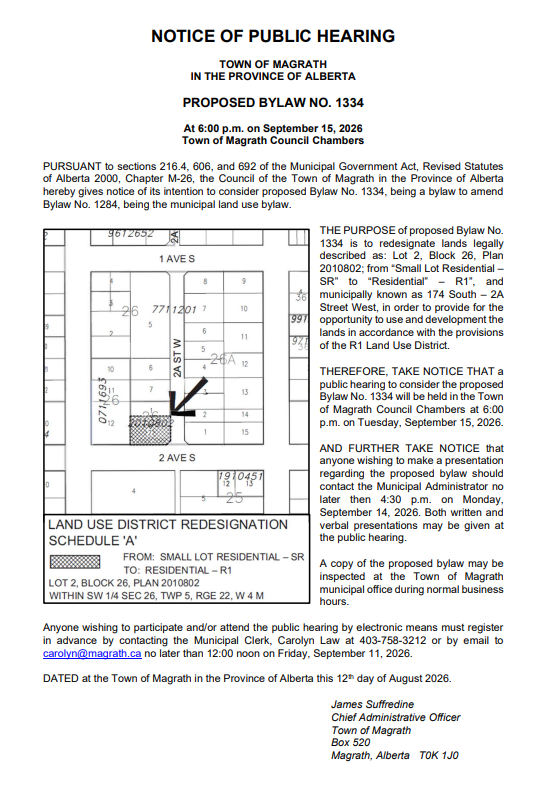
Notice of Public Hearing for Bylaw 1334 - Land Use Bylaw Amendment on September 15, 2026

FREQUENTLY ASKED QUESTIONS
1. What is rezoning?
Rezoning is the process of changing how a specific property can be used, as defined in the Town’s Land Use Bylaw. Each property in town is assigned a “district” (such as SR, R1, R4, etc.), which outlines what types of development and uses are allowed.
A rezoning application asks Council to consider changing that district to allow different types of development.
2. Why is the Town considering this rezoning?
The Town is considering this rezoning because a property owner (the applicant) has formally requested it.
Under the Town’s Land Use Bylaw and the Municipal Government Act, property owners have the right to apply to have their land rezoned. When sufficient information has been provided, the application is brought forward to Council for consideration, and Council follows the required public hearing process. It is important for Council to maintain an open-minded approach to requests like this to maintain fairness and ensure that each application is considered on its own merits, based on the information presented and public input received.
3. Does this mean the Town supports the rezoning?
Not necessarily. Considering a rezoning application does not mean that Council supports or will approve it.
Council’s role is to review the application, hear public input, and make a decision based on planning considerations, community impact, and applicable policies.
4. What does SR vs. R1 mean?
SR – Small Lot Residential: Provides for residential development on smaller residential lots, with development requirements specific to the SR District.
R1 – Residential: Provides for a low-density residential environment, primarily in the form of single-detached dwellings and associated uses.
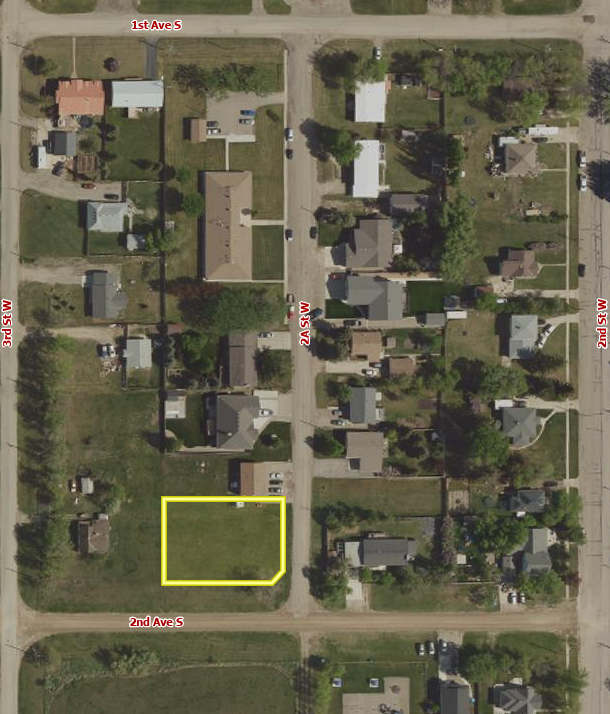
Rezoning from SR to R1 would mean that future development of the property would be subject to the uses and development standards of the R1 Residential District rather than the Small Lot Residential District.
To learn more about the regulations and permitted and discretionary uses within each zoning district, please refer to the Land Use Bylaw available here. Specifically, see Schedule 4, Page 13 (PDF Page 79) for SR zoning and Schedule 4, Page 9 (PDF Page 75) for R1 zoning.
5. Is any development approved if the rezoning passes?
No. Rezoning only changes what could be allowed on the property.
If approved, any future development or use would still be required to go through the Town’s development permit process, unless specifically permitted under the Land Use Bylaw. Specific plans would be reviewed to determine whether the proposed development complies with the requirements of the R1 District and whether the proposed use is permitted or discretionary.
6. How can residents provide input?
Residents can share their feedback in the following ways:
- Register to participate in the Public Hearing by contacting Carolyn Law at 403-758-3212
- Submit written comments or make a verbal presentation in accordance with the deadlines identified in the Public Hearing Notice
Both written and verbal presentations may be given at the Public Hearing.
Anyone wishing to participate electronically must register by contacting Carolyn Law at 403-758-3212 or carolyn@magrath.ca no later than 12:00 noon on Friday, September 11, 2026.
7. What does Council consider when making a decision?
Council may consider:
- Compatibility with surrounding land uses
- Suitability of the property for the proposed designation
- Impacts on infrastructure and services
- Drainage and other site constraints
- Alignment with applicable statutory plans and the Land Use Bylaw
- Feedback from residents and stakeholders
8. What are the possible outcomes?
After the Public Hearing, Council may:
- Approve the rezoning
- Approve it with changes
- Defeat (deny) the rezoning application
9. Why doesn’t the Town refuse the application before a hearing?
The Town follows a legislated process. Once sufficient information has been provided with a land use amendment application, the Development Officer submits the application to Council. Council must then follow the procedures established in the Municipal Government Act, including the requirements related to notice and public hearings.
This gives the applicant an opportunity to present their proposal, ensures transparency, and gives the public an opportunity to be heard before Council makes a decision.